
7-Eleven Is Reinventing the Convenience Store — One Concept at a Time
Walk into one of 7-Eleven's newer Hong Kong locations and you might not immediately recognise it. The diagonal shelving, layered green aesthetics, specialty coffee bar, hot food counter, blind box wall and K-pop merchandise zone tell a different story from the convenience store most people grew up with. This is a deliberate transformation, and it is accelerating.
Under DFI Retail Group, 7-Eleven Hong Kong and Macau has spent the past year opening a series of concept stores that reimagine what a convenience visit can look, feel and taste like. The effort spans multiple formats, districts and now crosses into Macau, with Patrick Lui, Managing Director of 7-Eleven Hong Kong and Macau, summing it up plainly: "We are no longer just about cigarettes and drinks."
Where It Started: Causeway Bay, July 2025
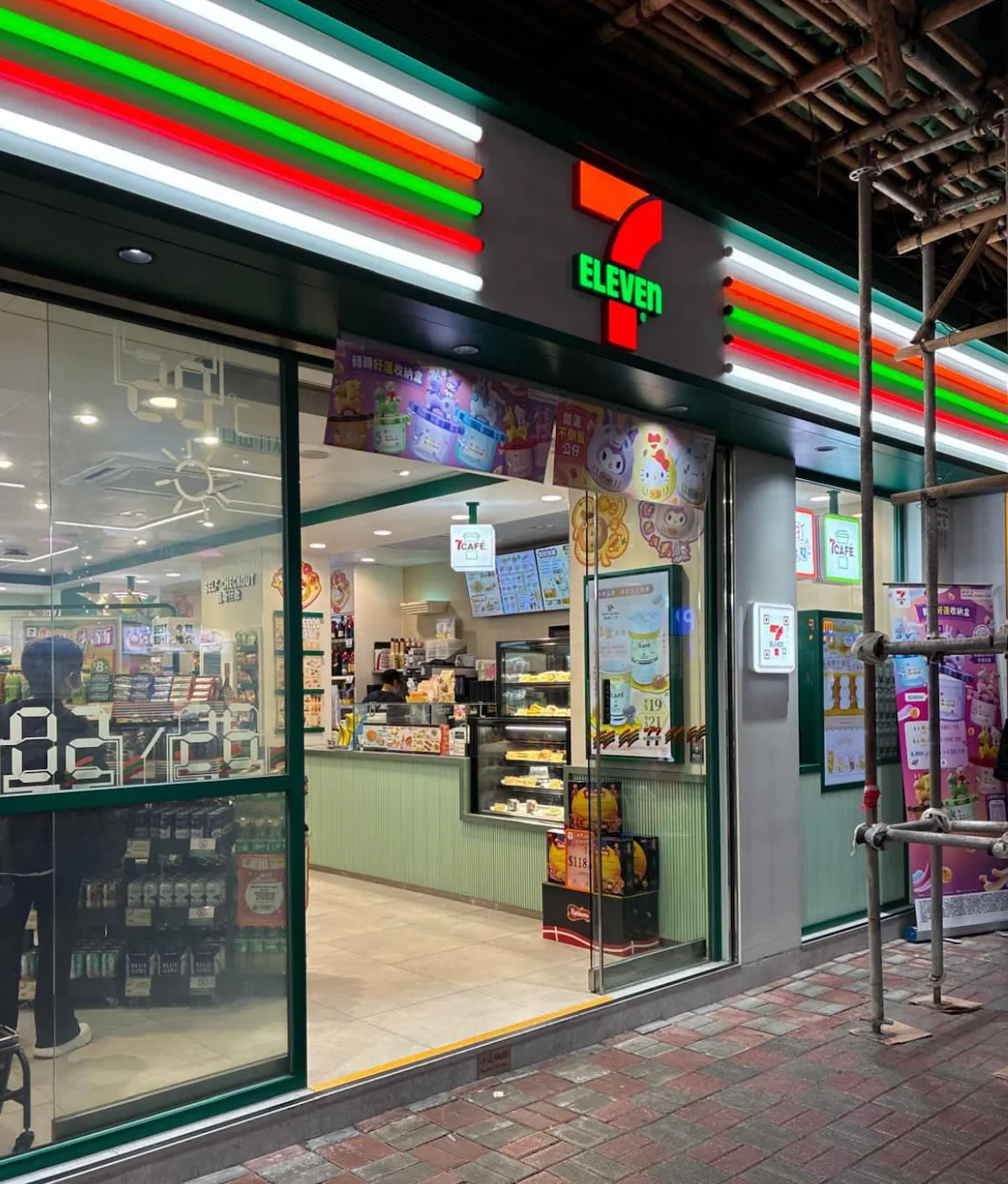
The blueprint for 7-Eleven's concept store strategy took shape in Causeway Bay, when the brand opened its first concept location at Shop G, G/F, Pun Tak Building, 478-484 Lockhart Road in July 2025. The store operates 24 hours and remains the clearest statement of the brand's new direction.
Three pillars defined the design from the start: innovative retail design, digital-first technology and a more diverse fresh food experience. None of these sounds radical in isolation, but together they mark a meaningful break from the grab-and-go model that convenience retail has relied on for decades.
The interior draws on Hong Kong's visual culture — the green of the Star Ferry, trams, street mailboxes — and brings it into the store through layered shades of green, soft lighting and natural daylight. Shelves run at diagonal angles rather than straight rows, adding visual depth and encouraging browsing rather than speed-shopping. The effect is a space that feels genuinely comfortable rather than transactional.
On the technology side, the Causeway Bay store became the first 7-Eleven in Hong Kong to replace traditional shopfront windows with multi-purpose transparent display screens showing real-time weather, date and time, and even product suggestions based on conditions outside. Inside, dynamic digital screens carry the latest promotions from 7CAFÉ and the Tsat Jai Sik Dong food brand.
The food offer is where the Causeway Bay store generated the most attention at launch. Tsat Jai Sik Dong — 7-Eleven's own ready-to-eat brand — introduced a debut collaboration with local brand Master Ngan, bringing dishes such as Minced Pork Stirred Noodles, Beef Offal Stirred Noodles and Satay Beef Tripe Stirred Noodles to the counter alongside existing classics like siu mai, fish balls and Hong Kong-style milk tea. A Made-to-Order series also debuted here, including Pistachio and Hazelnut Cocoa flavoured egg waffles and a range of thick egg and luncheon meat sandwiches.
7CAFÉ, the brand's in-house coffee programme, is central to the concept. The blend holds a Gold Medal from the International Coffee Tasting Awards (IIAC), earned the Specialty Grade certification from the Specialty Coffee Association and Coffee Quality Institute, and is freshly roasted in Hong Kong under the guidance of the China Champion of the World Coffee Roasting Championship. Younger shoppers are also targeted through 7CAFÉ's signature fruit coffees, fruit teas and bubble milk teas.
One sustainability detail quietly sets the Causeway Bay store apart: the in-store seating and tables are made from 14,876 recycled wooden chopsticks, reducing carbon emissions by approximately 724 kgCO₂e. It is a small gesture woven into the fabric of the store's identity rather than a standalone announcement.
Kai Tak Sports Park: Experience, K-Pop and Pet Cakes, February 2026
The second concept location opened in February 2026 at Kai Tak Sports Park, one of Hong Kong's most visible new lifestyle and sports destinations.
This store expanded the concept in new directions. Alongside the ready-to-eat food and 7CAFÉ offer, the Kai Tak store introduced a wider merchandise strategy built around themed zones. A Fun Zone targets K-pop fans with idol merchandise and collectible card machines. A Pet Zone offers accessories, snacks and chilled gourmet pet cakes from Lifetastic Petisserie.
The inclusion of a dedicated pet zone reflects an understanding of how Kai Tak's residential and visitor mix differs from Causeway Bay's retail crowd. The store was designed for both nearby residents and visitors to the Sports Park, bringing 7-Eleven's core convenience proposition into a format with longer dwell times and more reasons to explore.
Inside Retail Asia reported that the store is part of 7-Eleven Hong Kong's broader strategy to combine everyday convenience with a wider product mix and experiential retail elements, responding to evolving consumer expectations rather than assuming that speed and accessibility alone are sufficient.
Celebrating 45 Years: The Classic "Red House" Returns, April 2026
Not every opening in 2026 has been forward-looking. In April, 7-Eleven marked its 45th anniversary in Hong Kong with a project that looked backward — intentionally.
Design studio Plaap Design was commissioned to recreate the façade of 7-Eleven's very first Hong Kong store in Happy Valley, restoring the original "Little Red House" design from 1981. The transformation was completed in just 48 hours, using streamlined, high-impact design methods that Plaap described as touching both ends of 7-Eleven's Hong Kong timeline.
The project ran alongside a broader 45th anniversary campaign that also included theme stores featuring Hong Kong's neon signs and minibus plates — visual icons of the city's street culture — as part of the brand's effort to connect its history with its current identity.
The anniversary activations were more than nostalgia. They underlined that 7-Eleven's relationship with Hong Kong is long and embedded, and that the current concept store rollout is a continuation of that local presence rather than a departure from it.
Scaling the Model: 20+ Concept Stores Planned for 2026
The pace of openings is not slowing down. The Standard reported in April 2026 that 7-Eleven Hong Kong planned to open more than 20 new ready-to-eat concept stores within the year, as part of a push deeper into daily meals and digital services.
Patrick Lui stated that the brand's mobile app now has 300,000 monthly active users, offering customers a digital layer on top of the physical store experience. The app connects with the EasyCollect pickup zone available at concept locations, allowing queue-free collection at any time of day.
The Kai Tak store's signing event with celebrity-branded items and anime merchandise in March drew significant footfall, demonstrating how the concept store format can attract event-style visits rather than just routine top-up shopping. The Tsat Jai Sik Dong food lineup continues to grow through local collaborations, including the ongoing Master Ngan partnership introduced in Causeway Bay.
The target of 20-plus openings within a single year signals that 7-Eleven is treating the concept store format not as a premium experiment limited to flagship locations, but as a scalable model that can be adapted across different districts and communities.
Crossing to Macau: The First Concept Store Opens, 14 August 2026
On 14 August 2026, 7-Eleven brought the concept store format across the water for the first time, opening Macau's first 7-Eleven concept store at Macau Plaza, Avenida Doutor Mário Soares N 81–113 / Avenida do Infante D. Henrique N 43–53A / Rua do Dr. Pedro José Lobo N 2–16A. The store operates from 7:00am to 11:00pm.
The Macau opening follows the same three-pillar philosophy — innovative retail space design, exploratory shopping experience and a wider range of ready-to-eat food — but reshapes it for a market with a very different consumer mix. As a major international tourism and leisure city, Macau draws visitors and locals with distinct shopping habits, and the concept store was designed to serve both.
The design language is consistent with the Hong Kong stores: 7-Eleven's signature green in multiple shades, layered with soft lighting and natural light to create a clean and energetic atmosphere. Shelving runs along both side walls and draws inward, opening up the floor and encouraging customers to move naturally between zones.
Where the Macau store distinguishes itself is in its collectibles offer. A dedicated blind box and collectibles zone features the IP pieces, trend accessories and collectible toys that younger shoppers across Asia are currently chasing, with limited editions arriving regularly to keep collectors and trend watchers returning. DFI Retail Group describes this zone as positioning the store as "a new home for trendy toys in Macau" — a category that has taken hold strongly across Hong Kong, mainland China and Southeast Asia.
The food side brings familiar elements from Hong Kong: 7CAFÉ specialty coffee and the Tsat Jai Sik Dong menu of siu mai, fish balls, stirred noodles and milk tea. For office workers, students and tourists alike, the ready-to-eat offer provides a practical complement to the discovery-driven merchandise experience.
Patrick Lui commented on the Macau launch: "Macau is a market with real potential, and customers here are expecting more from their shopping experience and their quality of life. 7-Eleven has been part of this city for many years, and staying close to what customers want has always shaped how we grow. This store is about more than convenient shopping. We want it to be a place of discovery for residents and visitors alike."
The Logic Behind the Concept Store Strategy
Taken together, the concept store openings across Causeway Bay, Kai Tak, Tseung Kwan O and now Macau reflect a coherent response to what is happening in retail more broadly.
Consumer expectations have shifted. A convenience store judged only on how quickly it meets an immediate need is competing on an increasingly narrow basis — smaller product ranges than supermarkets, slower service than delivery apps, less atmosphere than cafés. The concept store format addresses all three pressures at once, by making the in-store visit worth having in itself.
Each location has been tuned to its neighbourhood. Causeway Bay gets digital screens and a 24-hour format for a dense retail district. Kai Tak gets a Pet Zone and idol merchandise for a newer residential and leisure hub. Macau gets a collectibles wall and tourism-ready food for a city where both residents and international visitors form the customer base. The pillars are consistent; the execution is localised.
The scale ambition is also notable. Twenty-plus openings in a single year goes well beyond test-and-learn mode. DFI Retail Group is treating the concept store as a network-wide upgrade, not a one-off flagship exercise.
Key Store Details
Causeway Bay Concept Store (first opened July 2025)
Address: Shop G, G/F, Pun Tak Building, 478-484 Lockhart Road, Causeway Bay, Hong Kong
Opening hours: 24 hours
Kai Tak Sports Park Concept Store (opened February 2026)
Location: Kai Tak Sports Park, Hong Kong
Key features: Fun Zone (K-pop merchandise, collectible card machines), Pet Zone (Lifetastic Petisserie), blind boxes, 7CAFÉ, Tsat Jai Sik Dong
7-Eleven 45th Anniversary "Red House" Store (April 2026)
Location: Happy Valley, Hong Kong
Design by Plaap Design — restored original 1981 façade in 48 hours
Macau First Concept Store (opened 14 August 2026)
Address: Shop P, V & W, G/F, Macau Plaza, Avenida Doutor Mário Soares N 81–113, Macau
Opening hours: 7:00am to 11:00pm
By F.V. in August 2026
Pictures by Roméo A. on Unsplash and David Clarke.
Sources
DFI Retail Group – 7-Eleven Hong Kong Launches New Concept Store in Causeway BayDFI Retail Group – Macau's First 7-Eleven Concept Store Opens Its Doors
Inside Retail Asia – 7-Eleven Hong Kong unveils experience-focused store at Kai Tak Sports Park
The Standard – 7-Eleven Hong Kong to open 20+ ready-to-eat concept stores this year
Plaap Design – 7-Eleven 45th Anniversary Concept Store

.webp)