

Prime Space, New Players: The Shift Reshaping Causeway Bay Retail
The departure of H&M from Paterson Street isn't just a retail story — it's a signal about where Hong Kong's prime leasing market is heading.
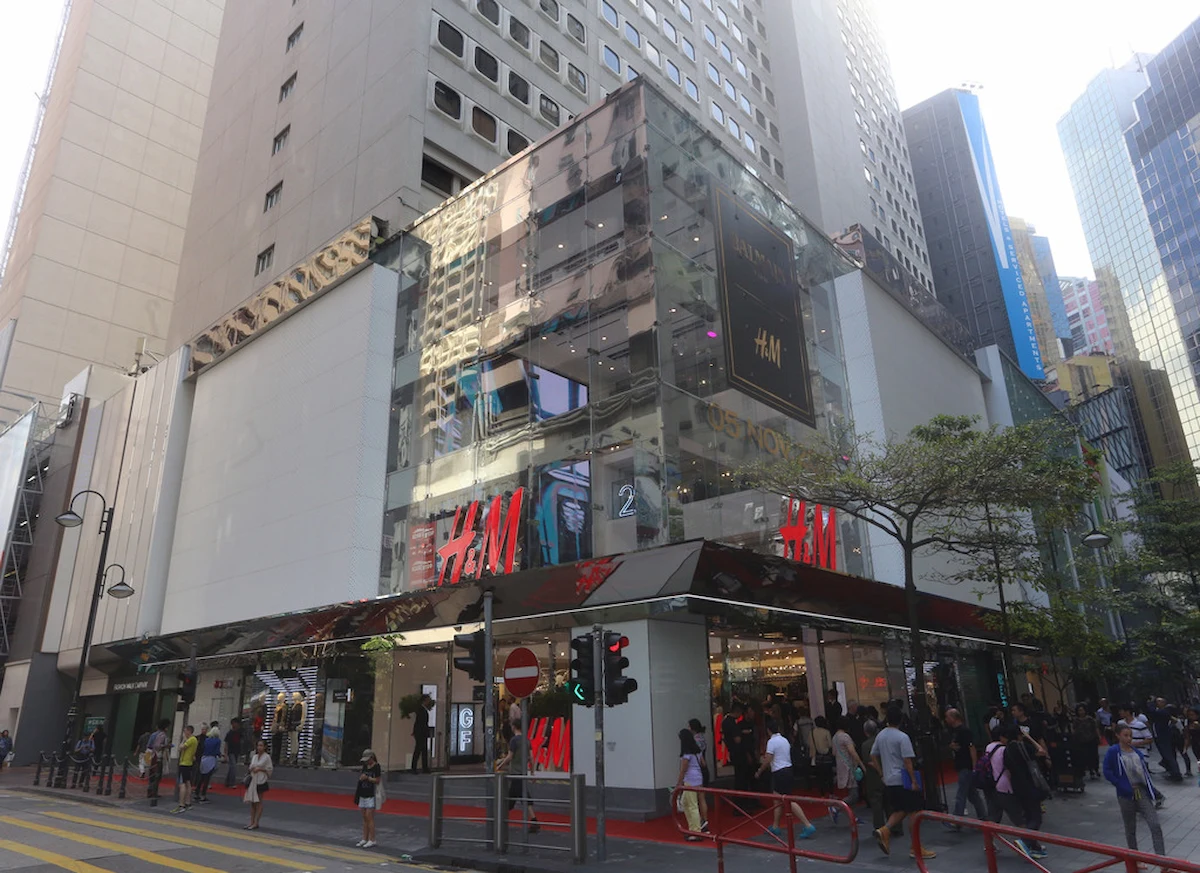
For years, the H&M flagship on Paterson Street was one of those fixtures of Causeway Bay that you barely noticed precisely because it had always been there. Anchoring a corner of Fashion Walk since 2015, the store became part of the neighbourhood's furniture — a reliable constant in one of Asia's most competitive retail corridors. That era is now officially over. H&M shuttered both its Causeway Bay flagship and its Festival Walk branch in February 2026, leaving only a single remaining outlet in Tsuen Wan Plaza. What was once a network of 28 stores across the city has been reduced to one.
But the space H&M left behind didn't stay empty for long — and who has moved in tells us a great deal about where Hong Kong retail is going next.

Enter W.Management

The new name on the lease is W.Management (WM), a fashion retail operator founded in 2023 and headquartered in Ningbo. Despite its relative youth as a company, WM has already built a footprint of more than 30 stores across mainland China's top-tier cities, including Beijing and Shanghai, and has generated considerable buzz for its approach to in-store experience. The brand is heavily inspired by the Brandy Melville aesthetic — prioritising visual impact, elaborately designed fitting rooms, camera-friendly lighting, and the kind of carefully curated staff presence that turns a store visit into content. Queues stretching hundreds of people have greeted some of its mainland store openings.
WM has reportedly secured approximately 30,000 square feet of the former H&M space — roughly two-thirds of the total footprint — at a reported rent of just over HK$2 million per month. That figure is striking for two reasons. On one hand, it is a substantial commitment for a brand making its first major international move. On the other, it represents a dramatic compression from the HK$10 million monthly that H&M was paying at the peak of Hong Kong's retail boom, and even well below the sub-HK$4 million figure H&M had negotiated down to in the post-COVID period. For Hang Lung Properties, which owns the Fashion Walk mall, finding a credible occupant willing to commit at this scale — and at a commercially viable rent — is a meaningful win.
According to market sources, WM is likely to take the first and second floors of Hang Lung Centre, while the 10,000-square-foot ground floor is reportedly being eyed by Lung Fung Group, a local pharmacy and beauty operator, at around HK$1.2 million per month. If confirmed, this three-way division of a formerly single-tenant anchor space is itself an instructive case study in how landlords are adapting to a new retail reality: fewer mega-tenants willing to absorb enormous floor plates at premium rents, and a growing willingness to work with a curated mix of occupants across different verticals.
The Broader Pattern: Chinese Brands as Hong Kong's New Retail Anchors
WM's move is part of a clearly identifiable wave. Over the past two to three years, a succession of Chinese brands have targeted Hong Kong's prime retail corridors — not primarily as end markets, but as springboards for international credibility and regional visibility. Laopu Gold took over a former Burberry flagship in Tsim Sha Tsui in 2023 and subsequently expanded into IFC Central. Perfumery To Summer opened its first Hong Kong branch in Causeway Bay last year. Mao Geping Cosmetics chose Harbour City for its local debut. These are not budget operators filling vacated space at distressed rents — they are brand-builders making deliberate, high-profile location choices.
For commercial real estate in Hong Kong, this is a structural shift worth paying close attention to. The legacy model of prime retail space anchored by established Western or Japanese chains — the H&Ms, the Gap flagships, the department store concessions — is being replaced by something different. Chinese brands, particularly those targeting the Gen Z consumer, tend to treat their physical stores as media assets as much as transactional spaces. Store design, staff aesthetics, lighting, social media virality — these are primary considerations, not afterthoughts. The result is that these brands are willing to invest heavily in fit-outs and take on meaningful rental commitments, but they also have very specific requirements around space configuration, ceiling heights, and visibility.
This creates both opportunities and new considerations for landlords and property owners in prime districts. The demand is real, the brands are well-capitalised, and the footfall they generate — particularly among younger consumers — can be significant. But understanding what these tenants need, how to evaluate their covenant strength, and how to structure leases that work for both sides requires a level of market intelligence that goes beyond standard retail leasing frameworks.
What This Means for Causeway Bay Specifically
Causeway Bay remains one of the highest-footfall retail districts in Hong Kong, but its tenant mix has been in visible transition. The departure of multiple Western fashion chains over the past several years has opened up meaningful floor space in buildings that were historically extremely difficult to enter. For Chinese brands with expansion ambitions, this creates an unusual window — prime locations at rents that, while still substantial in absolute terms, represent genuine value relative to historical benchmarks.
For existing landlords in the area, the key question is how to attract and retain the next generation of anchor tenants. The WM deal suggests that the appetite is there among well-positioned Chinese brands, but these operators are selective and move quickly. Spaces that sit vacant too long risk losing momentum; equally, landlords who understand the new tenant landscape early are better positioned to negotiate from strength.
The renovation timeline for WM's new store has not yet been confirmed, with some speculation pointing to a possible opening later in 2026. When the boarding eventually comes down on Paterson Street, it will mark more than just a new store opening — it will be a visible confirmation of a shift in the retail geography of one of Hong Kong's most watched commercial corridors.
A Moment of Transition, and of Possibility
The H&M chapter in Causeway Bay lasted over a decade and spanned boom years, political turbulence, a global pandemic, and a slow, uneven recovery. Its conclusion is not a story of failure so much as it is a story of change — a global brand recalibrating its footprint in a market that has itself recalibrated significantly.
What comes next, anchored by W.Management and shaped by the broader entry of Chinese retail operators into Hong Kong's prime locations, represents a genuinely new chapter. The fundamentals that have always made Causeway Bay attractive — the foot traffic, the international visibility, the density of retail infrastructure — remain intact. What is changing is who is best positioned to leverage them.
At Hollies, we track these movements closely because they matter directly to anyone making leasing or investment decisions in Hong Kong's retail property market. If you are a landlord with space in a prime corridor, or a brand evaluating your options in the city, this is exactly the kind of market intelligence that should be informing your strategy.
Published April 2026 — Author: FV, Hollies
Hollies is a Hong Kong-based commercial real estate agency specialising in retail, F&B, and office leasing. Explore our latest available properties and market insights at hollies-properties.com.
.webp)

.jpeg)


