

Central Crossing: The Project Quietly Redefining What Central Can Be
.webp)
At 118 Wellington Street, a landmark mixed-use development is about to change the conversation around prime commercial space in Hong Kong's most storied district.
There is a particular kind of ambition involved in building something new in the heart of Central. The district is Hong Kong's most scrutinised commercial address — every vacancy is noted, every new tenant discussed, every design choice evaluated against decades of accumulated expectation. To build there with genuine originality, and to do so while preserving rather than erasing the heritage fabric of the site, requires a level of conviction that goes beyond standard development logic. Central Crossing, the joint venture project from Wing Tai Properties and CSI Properties at 118 Wellington Street, appears to have that conviction in full.
With topping out now complete and a mid-2026 opening on the horizon, Central Crossing is moving from a project discussed in development circles to one that will soon become a physical reality in the streetscape of one of Asia's most competitive commercial corridors. For anyone with an interest in Hong Kong's retail, office, or hospitality real estate markets, it warrants close attention.
A Philosophy Built Into the Architecture
Before examining the individual components of Central Crossing, it is worth understanding the conceptual framework that underpins the entire project. The development's guiding proposition — "Where People and Inspiration Meet" — is not marketing language grafted onto a completed scheme. It reflects a genuine design philosophy constructed around four axes of intersection: crossing ideas (big and small), crossing cultures (local and global), crossing activities (work, rest, and play), and crossing time (past and future). That last axis is perhaps the most unusual in a market where new development so rarely acknowledges what came before it.
The ambition, as articulated by the project's lead design team at Foster + Partners — the globally renowned practice responsible for some of the world's most significant civic and commercial buildings — is to create "a world-class destination that elevates the neighbourhood and gives Hong Kongers a sense of pride." Michael Jones, Senior Partner and Lead Architect at Foster + Partners, has been instrumental in translating that ambition into built form, delivering a scheme that is simultaneously of its moment and deeply rooted in its location.
The creative team assembled around this project speaks to the seriousness of the undertaking. Beyond Foster + Partners for architecture, the developer has engaged Simon Thurley as heritage consultant, Prophet for brand strategy, Enea for landscape design, and Jouin Manku for interior design — a roster of international specialists that is more commonly associated with flagship cultural institutions than with speculative commercial development.
What Central Crossing Actually Is
At approximately 433,000 square feet, Central Crossing is a genuinely mixed-use development in the truest sense of the term — not a tower with a small retail podium, but a considered integration of Grade A office space, a luxury international hotel, a curated retail village, heritage preservation, and publicly accessible green open spaces. According to the developer's own positioning materials, it is currently the only new mixed-use development in Central — a distinction that carries real weight in a district where the pipeline of genuinely new, large-scale commercial schemes has been thin for years.
The project's four components — the Andaz Hotel (120 keys), Andaz Village (approximately 38,000 square feet of retail and F&B), the office tower (approximately 300,000 square feet of Grade A space), and approximately 15,000 square feet of public open space — are designed to function as an interconnected ecosystem rather than a stack of separate uses sharing a lobby.
The Connectivity Advantage: A Number That Commands Attention
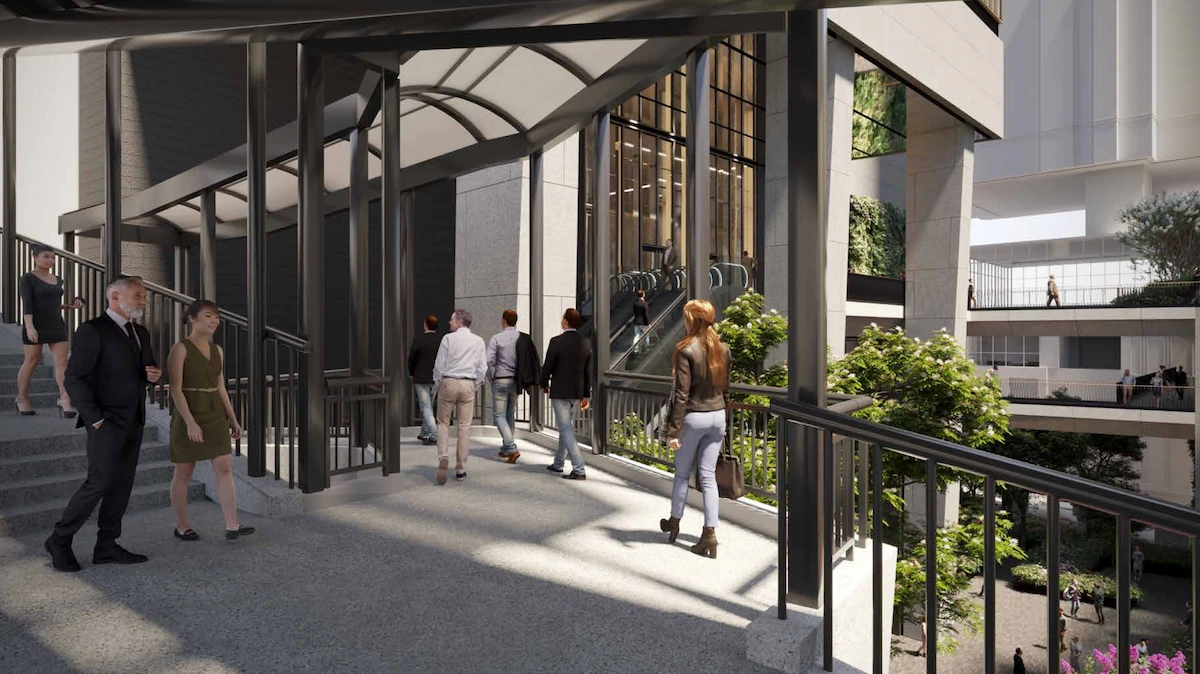
Location quality in Central is never simply about the address. It is about connectivity — the speed and ease with which people can reach a building, and the density of pedestrian flows that pass by it. On this measure, Central Crossing holds a structural advantage that very few sites in Hong Kong can match.
The development offers direct access to the Central–Mid-Levels Escalator, the world's longest outdoor covered escalator system, which carries over 78,000 passengers every single day — more than 28 million per year — running from the Mid-Levels residential district down through the heart of Central to the MTR and Airport Express. The site sits just 80 metres from Queen's Road Central, and a four-minute covered walk connects it to the IFC and the Airport Express terminal. For retail and F&B operators in particular, that figure of 78,000 daily escalator users is not an abstract connectivity metric — it is a captive audience passing directly through the development's front door.
Access into the site itself is designed to be maximally permeable. Multi-level entry points are provided from Gage Street to the north, Graham Street to the east, Cochrane Street via both escalator and steps, and Wellington Street for vehicle access — a configuration that ensures the project draws footfall from multiple directions simultaneously and avoids the pinch-point congestion that afflicts less carefully planned mixed-use schemes. The neighbourhood context reinforces the draw further: Central Crossing sits within easy walking distance of PMQ, Tai Kwun, the IFC, Central Market, The Landmark, the Mandarin Oriental, and Lan Kwai Fong — effectively at the intersection of Central's cultural, financial, and lifestyle gravitational fields.
A Retail Village Designed for Visibility and Dwell Time
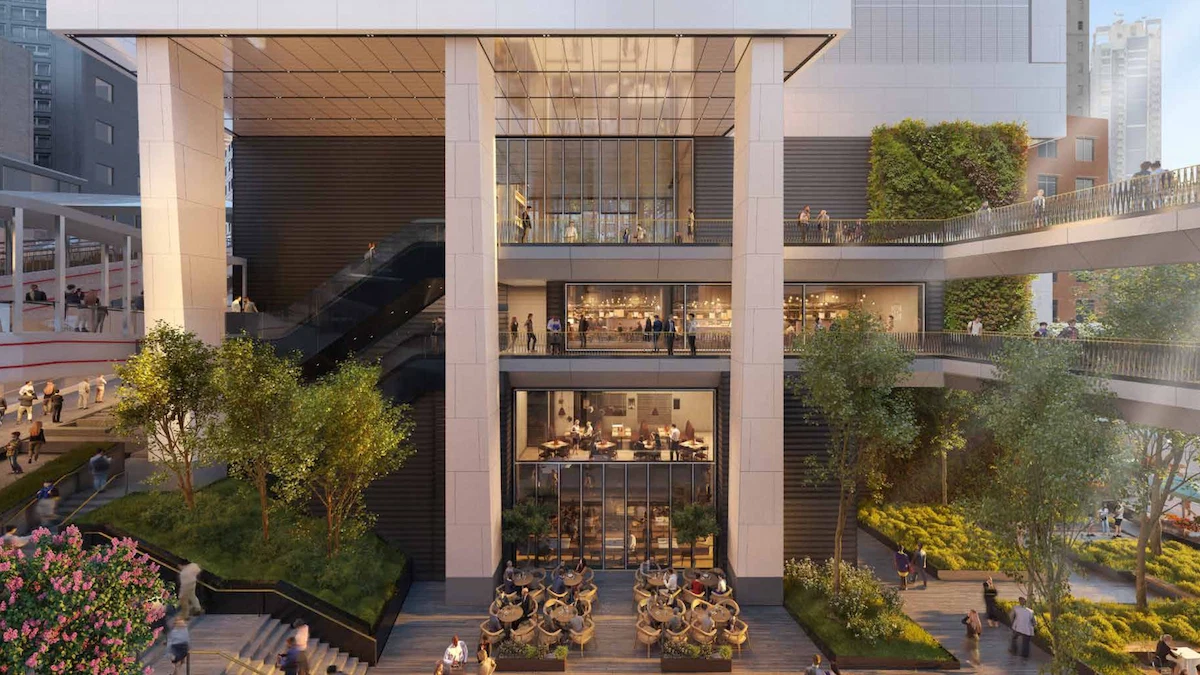
The retail proposition at Central Crossing — housed within the Andaz Village — is built around a logic that is quite different from conventional mall retail. The developer describes it as "the first and only in the world": a concept that combines trendsetting retail offerings with around-the-clock alfresco and signature dining experiences, embedded within a setting of strong cultural heritage. Rather than enclosed corridors optimised for throughput, the concept centres on high-visibility shopfronts integrated with open public space, creating an environment designed for genuine dwell time.
Across three retail floors — UG/F, 1/F, and 2/F — ten distinct shop units are laid out with direct frontage onto the escalator corridor and the project's open-air public realm. The 1/F level in particular connects directly to the Central–Mid-Levels Escalator landing, placing Andaz Village shops in immediate visual and physical proximity to the system's daily 78,000 users at the precise moment they step off or board. For F&B operators, the around-the-clock dining offer is a deliberate attempt to extend the site's active hours well beyond the conventional office-day rhythm — capturing the morning commuter, the business lunch crowd, the after-work diner, and the late-evening visitor in a single, continuously animated environment.
For prospective retail tenants, the combination of ground-level and elevated street visibility, open-air shopfront exposure, and an adjoining hotel generating consistent in-house footfall is a genuinely differentiated proposition. The Andaz brand, known globally for its design-forward, locally immersive positioning, tends to attract a guest demographic — younger, experience-oriented, internationally mobile — that is squarely within the target profile for premium lifestyle retail and F&B operators.
Heritage as an Asset, Not a Constraint
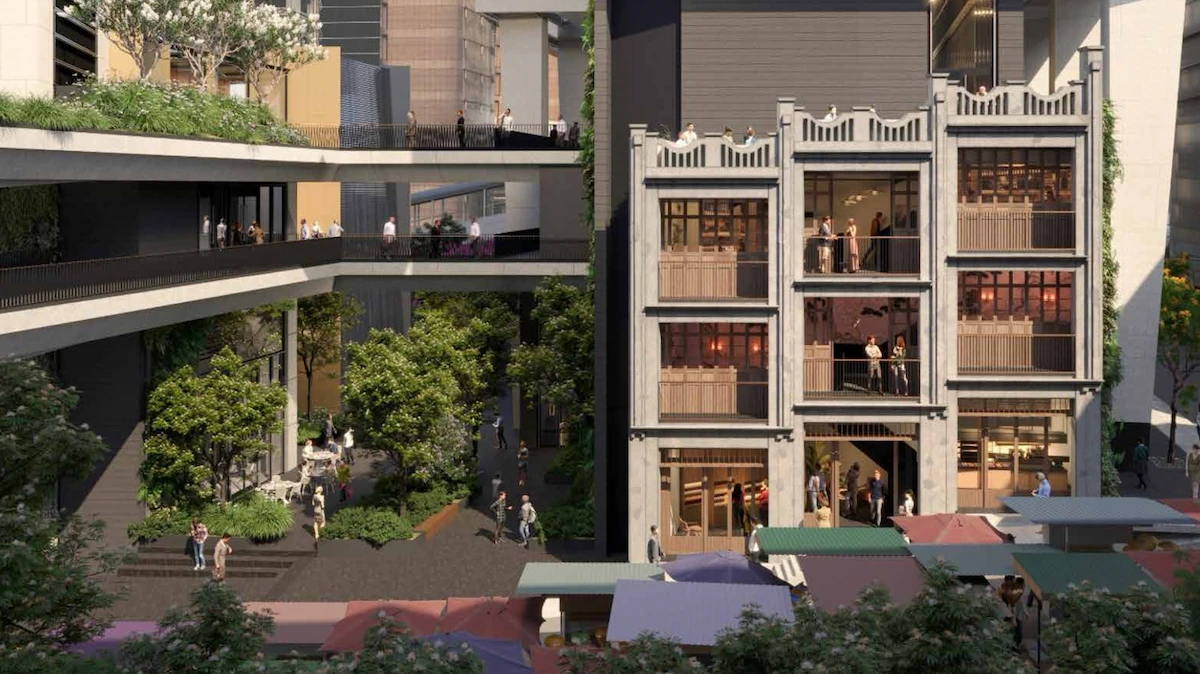
One of the most distinctive aspects of Central Crossing is its approach to the heritage structures on the site. The development preserves both Grade 1 and Grade 3 heritage buildings — the highest and a significant secondary tier of the Hong Kong government's grading system — integrating them as active components of the project's retail and public realm experience rather than isolating them as static exhibits.
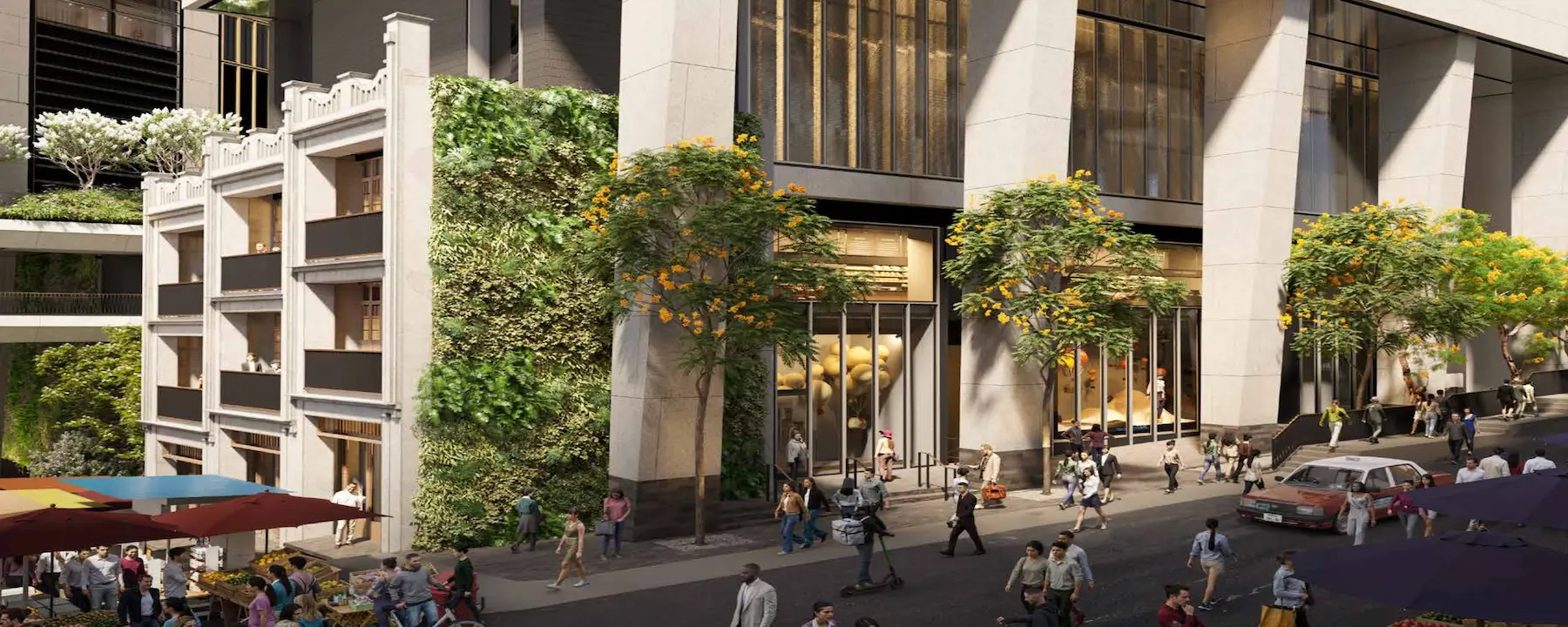
This approach gives Central Crossing a textural richness that is difficult to manufacture from scratch. The juxtaposition of Foster + Partners' contemporary glazed tower with the restored colonial-era heritage facades creates a layered streetscape of rare authenticity — one that resonates with both the professional community occupying the offices above and the broader public engaging with the retail and hospitality spaces at grade. The heritage buildings are visible from the escalator, from the open public plaza, and from the upper-floor terraces of Andaz Village, ensuring that the dialogue between past and future is embedded in the daily experience of the site rather than confined to a plaque on a wall. Simon Thurley's involvement as heritage consultant — he is one of the most respected figures in built heritage internationally — is a signal of how seriously the developers have taken this dimension of the project.
In practical terms, this means that the project's ground-level experience is markedly different from the polished uniformity of many modern mixed-use developments. In the current market, that differentiation is a genuine commercial advantage.
The Green Dimension: More Than Aesthetics
The public realm component of Central Crossing is substantial by any measure: approximately 15,000 square feet of publicly accessible wellbeing space, incorporating 7,000 square feet of vertical greenery, over 20 plant species, and enhanced water features. A 15-metre-wide air ventilation corridor has been designed into the project to optimise airflow and enhance outdoor comfort — a practical engineering response to Central's known urban heat island conditions, and one that meaningfully improves the usability of the open spaces in all but the most extreme weather.
For retail and F&B operators considering the site, this green infrastructure is commercially significant beyond its visual appeal. It creates a genuinely pleasant outdoor environment that supports alfresco dining and extends the usable hours of the open-air spaces across the day and into the evening. The ambition expressed by the developers is for this public space to function as "a green oasis where the public can find refreshment and moments of calm and rest" — a counterintuitive positioning for a prime Central address, but one that is well-aligned with the broader evolution of how people expect to inhabit city centres.
Hong Kong's First Andaz — and Asia's Flagship: A Hospitality Anchor with Real Commercial Pull
The hotel component is anchored by the Andaz brand under Hyatt, with 120 keys and premium event and social spaces designed in collaboration with Jouin Manku, whose portfolio of acclaimed hospitality interiors brings a distinctive aesthetic sensibility to the project. Andaz Hong Kong at Central Crossing will be not only the brand's first property in the city but its Asian flagship — a distinction that elevates the marketing significance of the address and brings meaningful international media profile to the wider development.
Crucially, this will also be the first luxury boutique hotel to open in Central in over a decade — a gap in the market that is itself a commercial statement. Hotel guests at a design-forward lifestyle property in this location represent a high-value and reliably recurring source of footfall for ground-level operators, and the Andaz positioning specifically attracts the kind of internationally minded, culturally engaged traveller who is most likely to engage with quality retail, independent F&B, and destination dining. The symbiosis between a well-positioned hotel and its adjacent retail and dining tenants is well-documented in comparable international mixed-use projects, and Central Crossing has been designed explicitly to capture this dynamic.
The Office Tower: Craft Where It Counts
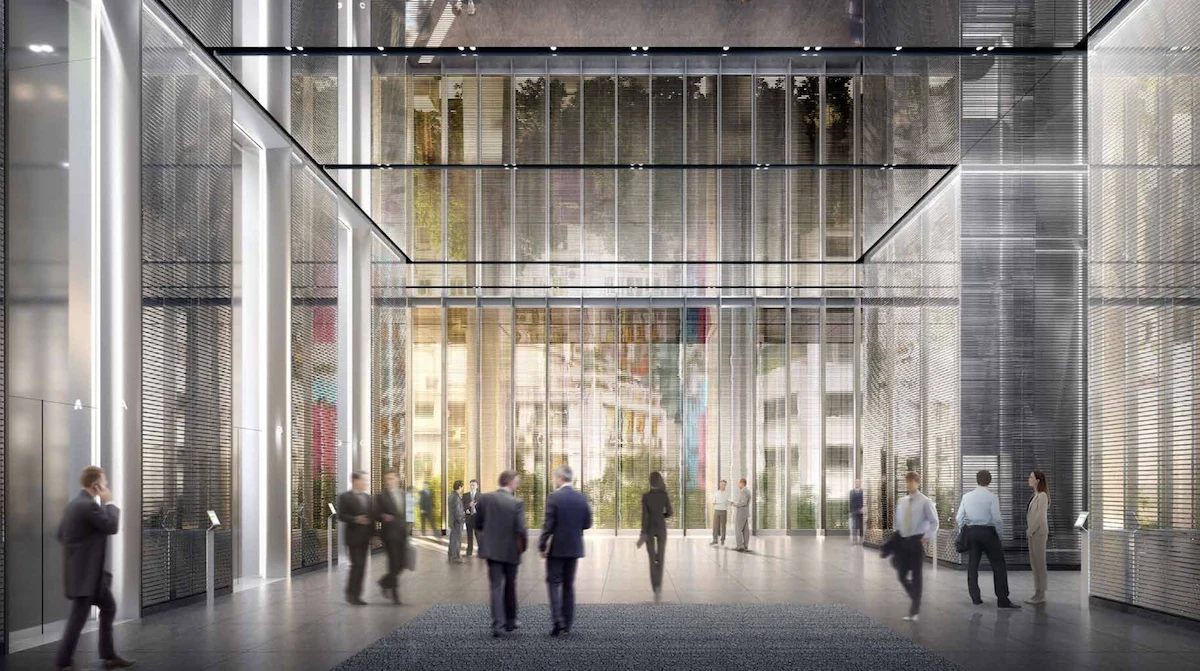
The office component occupies a 28-storey tower divided into two zones — a low zone running from floors 8 to 18, with typical lettable floor plates of 8,816 square feet, and a high zone running from floors 20 to 38, with typical plates of 9,155 square feet. The tower is certified to BEAM Plus Platinum, LEED Platinum, and WELL Platinum standards — a sustainability trifecta that reflects both genuine environmental ambition and a recognition that occupiers increasingly treat green credentials as a prerequisite rather than a bonus.
The split-core design is particularly noteworthy. By separating the service core to the perimeter rather than centralising it, Foster + Partners has maximised natural light penetration across the floor plate and created unobstructed interior spans that give tenants genuine flexibility in how they configure their space. Floor-to-ceiling glazing delivers views of Hong Kong's harbour and mountain backdrop — a feature that will not be lost on organisations for whom the quality of the working environment is a direct recruitment and retention argument. The 3-metre clear headroom and 150mm raised floor throughout further signal a specification pitched at occupiers with demanding technical and operational requirements.
What This Means for the Central Leasing Market
Central Crossing arrives at a moment when Central's commercial real estate market is navigating a period of genuine recalibration. Against this backdrop, the delivery of a thoughtfully designed, genuinely mixed-use asset — with unmatched pedestrian connectivity, preserved heritage character, a world-class architectural practice behind every design decision, and a credible hospitality anchor — is a net positive for the district's appeal and a meaningful new option for occupiers across all three use categories.
For landlords and developers watching from neighbouring properties, the Central Crossing model offers a case study in how to reposition a prime site for a market that increasingly values experience, authenticity, and environment over raw square footage. For tenants — whether in retail, F&B, or office — it represents one of the more compelling new entries into a district where genuinely differentiated space rarely comes available.
At Hollies, we will be watching the leasing progress of Central Crossing closely as the mid-2026 opening approaches. If you are evaluating commercial space in Central or the surrounding districts, this is a development worth understanding in detail.
Published April 2026 — Author: FV, Hollies
Hollies is a Hong Kong-based commercial real estate agency specialising in retail, F&B, and office leasing. Explore our latest available properties and market insights at hollies-properties.com.
Sources
- Wing Tai Properties / CSI Properties — Central Crossing Leasing Brochure (February 2025): wingtaiproperties.com
- The Standard — "Central Crossing expects to open in mid-2026", Gloria Leung (11 February 2026): thestandard.com.hk
- Wing Tai, CSI Team Up to Buy Site in Hong Kong’s Central for $1.5B (October 2017) Greg Isaacson : Mingtiandi.com
- Foster + Partners' Central Crossing skyscrapers top out in Hong Kong (Febraury 2026) Cajsa Carlson : deezen.com
- Central Crossing starts leasing, project expected to be completed in mid-2026 (September 2025) Longbridge Hong Kong

.jpeg)


