

A New Jewel in Central: Van Cleef & Arpels Opens Its Expanded Hong Kong Maison at Alexandra House
.webp)
On 29 June 2026, Van Cleef & Arpels opened the doors of its new Hong Kong Maison at Alexandra House, 18 Chater Road, Central — relocating from its long-standing home at Prince's Building, where it had resided since 2011. The move, to a two-floor, 564-square-metre space spanning the ground and first floors of Landmark Alexandra, is more than a change of address. It is a considered statement about where one of the world's most storied fine jewellery houses intends to position itself — in the city, in Asia, and in the global luxury landscape — for the next decade.
A Maison in Five Cities
The Hong Kong location is one of only five Van Cleef & Arpels Maisons in the world. The others are in Paris, New York, Seoul and Tokyo. The designation of "Maison" is deliberate and carries weight: it distinguishes these flagship spaces from standard boutiques, indicating that the location functions not merely as a retail point but as a full expression of the brand's identity — its history, its craft, its hospitality and its cultural programme.
That the fifth such address in the world sits in Hong Kong is significant. The city has long been a barometer for luxury retail ambition in Asia, and Van Cleef & Arpels' decision to invest substantially in a larger, more prominent Hong Kong presence signals continued confidence in the market at a moment when others have been more cautious.
Established in Paris in 1906 by Alfred Van Cleef and his brothers-in-law Charles and Julien Arpels, the Maison built its reputation across more than a century of jewellery craftsmanship. Its most coveted fine jewellery lines — the Alhambra, with its iconic four-leaf clover motif, and Perlée, with its elegant beaded detailing — sit alongside one-of-a-kind high jewellery creations and watchmaking. Fewer people know that the Maison also entered the fragrance world as early as 1920, a dimension the Hong Kong location actively showcases. Marc Leplingard, managing director of Van Cleef & Arpels for Hong Kong and Macau, notes that clients frequently discover the brand's full breadth for the first time at the Maison: "We bring clients into the history of Van Cleef & Arpels, unveiling the universe of Van Cleef & Arpels — inspiration, shapes, design, aesthetics."
Design: Nature, Curves and a Dreamy Facade
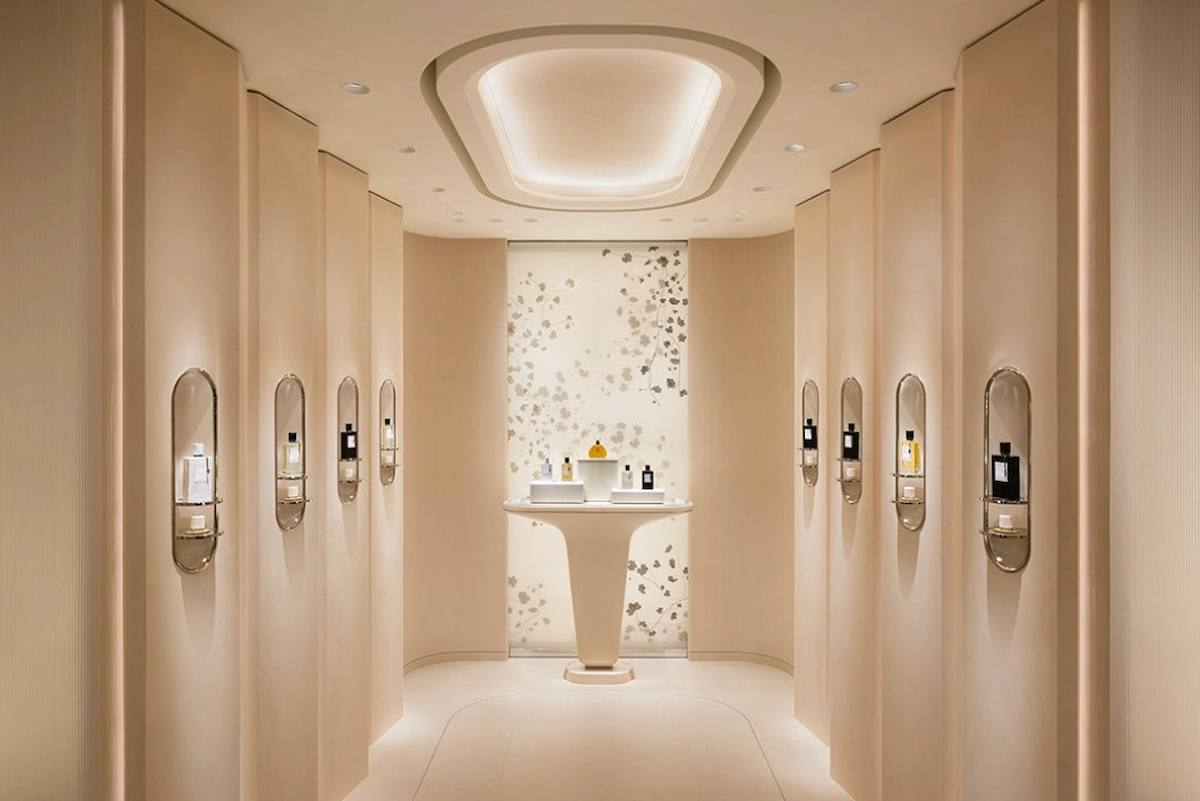
The physical space was designed by Paris-based Studio Jouin Manku, the creative partnership of Patrick Jouin and Sanjit Manku. The relationship between the studio and the Maison spans twenty years and includes the original 2011 Maison at Prince's Building — making this new Alexandra House space a kind of creative homecoming, a reimagining of the same city's flagship after two decades of shared evolution.
"We've been working with the Maison for a very long time, but every single project presents a completely fresh opportunity," Patrick Jouin told Hypebeast. "We constantly have to discover a new visual language to express the core identity of Van Cleef & Arpels."
The result is a space defined by the complete absence of harsh lines. The exterior facade, rendered in white stone and decorated with sculptural plaster petals, is designed to evoke petals and clouds — an effect that gives the entrance what the designers describe as a dreamy quality, quietly mysterious rather than loudly announcing itself, even on a street as commercially charged as Chater Road.
Inside, the ground floor is anchored by a grand staircase surrounded by planting areas and indoor greenery. The material palette draws on oak panelling, gold leaf, white, beige and laurel green — natural, unhurried tones calibrated to feel like a deceleration from the pace of the city outside. Everything curves. Private salons on the upper floor offer clients an intimate setting for personal appointments. A dedicated fragrance salon, inspired by the Maison's Place Vendôme flagship in Paris, adds a dimension rarely encountered in luxury jewellery retail.
One salon features walls of stone with rosy reflections, created in collaboration with L'ÉCOLE, School of Jewelry Arts — a cultural and educational institution associated with Van Cleef & Arpels that offers courses in jewellery history, gemology and the decorative arts to the general public. The presence of L'ÉCOLE's influence within the physical space reflects the brand's wider philosophy: that discovery and education are inseparable from the experience of fine jewellery.
As Sanjit Manku and Patrick Jouin put it in a statement: "It's a Maison that is open to people who are living [not far away] — to be installed there, to have the art, to be of the place."
The "Lighthouse" Philosophy: Inclusivity as Brand Strategy
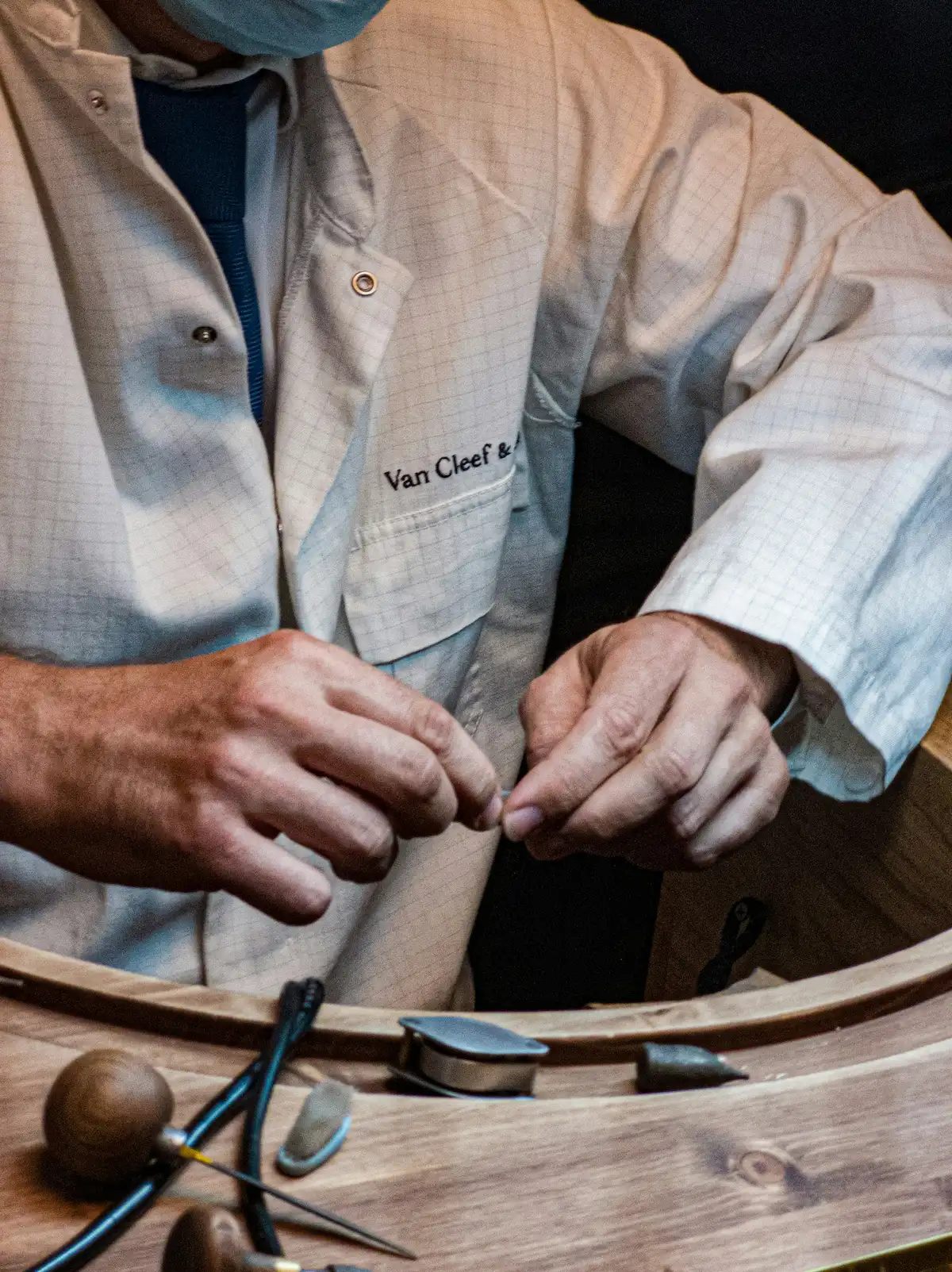
Managing director Marc Leplingard describes the Maison as "a lighthouse" — a metaphor that captures the democratic ambition at the heart of the brand's approach. "Whoever enters the Maison may just be discovering the brand or plan on purchasing something," he says. The statement holds more strategic weight than it might initially appear.
Van Cleef & Arpels creates rarefied objects. Its high jewellery pieces are, by their nature, accessible only to a very privileged few. But the brand has long understood that the cultivation of a wide, curious and culturally engaged audience is essential to its long-term health. A significant portion of the ground floor is devoted to temporary exhibitions exploring different themes, with displays featuring creations dating back to the Maison's earliest years. These are not sales floors masquerading as museums; they are a genuine invitation to engage with the heritage and philosophy of the house regardless of purchasing intent.
This is what Leplingard means by "lighthouse." It does not broadcast a single clear signal for buyers only. It glows for anyone who is drawn to it — including, crucially, the next generation of clients who may be only beginning to discover what Van Cleef & Arpels represents.
The Real Estate Context: Alexandra House and the US$1 Billion Landmark Transformation
The move from Prince's Building to Alexandra House is inseparable from one of the most significant commercial real estate projects currently unfolding in Hong Kong: the "Tomorrow's Central" transformation of Landmark, announced by Hongkong Land in June 2024.
The scale of the programme is extraordinary. Hongkong Land committed US$400 million of its own capital to the overhaul, with a further estimated US$600 million in capital investment coming from its luxury retail tenants — bringing the total programme to over US$1 billion. The transformation encompasses the full Landmark complex: the four interconnected buildings of Landmark Atrium, Alexandra House, Chater House and Prince's Building, linked by a network of covered walkways and pedestrian bridges that form one of Hong Kong's most distinctive shopping and office circuits.
The project's ambition is to more than double the retail footprint of Landmark's anchor tenants. The roster of brands involved reads like a comprehensive survey of the global luxury industry: Cartier, Chanel, Dior, Hermès, Louis Vuitton, Prada, Saint Laurent, Tiffany & Co. and Van Cleef & Arpels are all part of the investment programme. Scheduled for completion in April 2027, the programme represents Hongkong Land's clearest statement of intent regarding Central's enduring status as Hong Kong's luxury retail heart.
Alexandra House itself is a 36-floor mixed-use tower at 16–18 Chater Road, completed in September 1976, designed by P&T Architects & Engineers and owned entirely by Hongkong Land. Its location — adjacent to Landmark Atrium, above the Admiralty–Central pedestrian corridor and steps from the Hong Kong Stock Exchange — makes it one of the most commercially strategic addresses in the city. The decision to bring Van Cleef & Arpels' expanded Maison here, rather than retaining it in Prince's Building, reflects a deliberate repositioning of Alexandra House as a prestige retail anchor within the broader Landmark reconfiguration.
For Van Cleef & Arpels, the enlarged 564-square-metre space represents a meaningful increase in footprint compared to the previous Prince's Building location. The two-floor format allows for a cleaner separation of functions: exhibition and discovery on the ground floor, private consultation and high jewellery presentation on the first floor. That spatial generosity, in a Central building where every square metre carries one of the highest per-unit retail costs in the world, is itself a signal of confidence.
The Landmark renovation has also seen the Mandarin Oriental The Landmark, which shares the complex, reopen in June 2026 following an extensive refurbishment. Prada, another anchor tenant, has installed the largest Prada flagship in Asia within the complex. Van Cleef & Arpels' Maison, as one of the programme's headline openings, sits within this broader story of Central reinventing itself as a post-pandemic luxury destination of the first order.
Hong Kong as Global Testing Ground
The opening of the new Maison also arrives at a moment when Hong Kong's role as a stage for international luxury brands is being reaffirmed after several turbulent years. The South China Morning Post has noted that the city functions increasingly as a proving ground — not only for Western luxury houses seeking Asian footholds, but also for mainland Chinese brands testing international ambition. Van Cleef & Arpels' investment cuts across that dynamic: a European Maison of 120-year heritage deepening its commitment to a city that remains, despite every complexity, one of the world's most concentrated markets for high-end goods.
For Van Cleef & Arpels, Hong Kong is not simply a market to be served. The Maison format itself — the exhibitions, the salons, the educational dimension, the fragrance space — turns the Alexandra House location into something more akin to a cultural institution than a retail outlet. In a city where the competition for luxury consumer attention is as intense as anywhere on earth, that distinction may prove to be the brand's most durable competitive advantage.
By F.V. for Hollies Properties - August 2026
.webp)

.webp)


